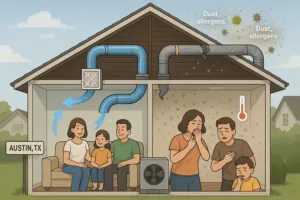



235 million people worldwide suffer from asthma — and if you live here in Central Texas, you already know our hot, humid summers do not make breathing any easier. The good news? An asthma dehumidifier can make a real difference. The two biggest triggers hiding inside your home are dust mites and mold, and both of them love our Texas humidity. With indoor humidity levels regularly pushing past 60% during our sweltering summer months, knowing how dehumidifiers help with asthma is not just useful — it’s essential.
We take your health seriously at Texas Reliable Services. This guide will walk you through everything you need to know — from picking the right unit to understanding the ideal humidity levels for asthma relief. Our HVAC team is here to help you and your family breathe easier, all year long.
Why Central Texas Climate Makes Asthma Worse
High Humidity Levels in Austin and Surrounding Areas
Hot, humid air triggers asthma symptoms just as badly as cold, dry air, according to Dr. Hetu Y. Parekh, an allergist at Austin Regional Clinic. People with baseline asthma often find themselves losing control of symptoms during our Texas summers — even while sticking to their daily inhalers. And it goes beyond just feeling uncomfortable.
When temperatures climb here in Austin, so does the air quality index (AQI). Austin typically holds lower AQI levels than other major Texas cities, but recent periods have pushed our area into moderate to high AQI categories. That means more fine particle air pollution hanging in the air you breathe every day. Dr. Parekh points out that pollen is not the only concern — fine particle pollution alone can set off serious asthma symptoms.
The research backs this up:
-
A large-scale study found a pooled odds ratio of 1.0489 linking humidity directly to asthma risk
-
Asthma patients over age 14 face a 1.3-fold higher relative risk of doctor visits when exposed to 95% humidity
-
High temperatures produce ground-level ozone — a smog component that irritates airways and triggers attacks
-
In 2023, eighteen Texas counties in the Dallas-Fort Worth and Houston-Galveston areas exceeded national ozone standards, affecting more than 12 million people
Humid air is denser, and that density makes it harder to breathe. It also keeps pollutants, pollen, dust, and smoke suspended right where you can inhale them — the perfect storm for asthma flare-ups.
How Dust Mites Thrive in Humid Texas Homes
Dust mites multiply fast when indoor humidity crosses 50%. They settle into your bedding, carpets, and upholstered furniture, and they are not easy to spot — these are microscopic creatures. Their dead bodies and waste particles are what actually trigger asthma attacks in sensitive people.
The Environmental Protection Agency recommends keeping indoor humidity between 30% and 50% for a reason. Above that range, your home becomes the ideal habitat for dust mites. For Central Texas homeowners, this is a real and ongoing challenge. Outdoor moisture seeps indoors regularly during our humid months, and without active humidity control, dust mite populations grow unchecked.
Medical professionals treating Austin residents specifically recommend dehumidifiers to help alleviate these breathing issues. The connection between dehumidifiers and asthma is not complicated — control the moisture, and you cut off the environment dust mites need to survive.
Mold Growth in Central Texas: A Year-Round Problem
Mold does not take a season off here in Central Texas. Once humidity hits 60% or higher, mold becomes a serious concern. Bathrooms, basements, and kitchens are common problem spots, but really any area where moisture collects can become a breeding ground for mold spores. When those spores go airborne, they trigger severe respiratory reactions — especially in people who already deal with asthma.
Heavy rainfall and flooding are familiar events in Central Texas, and they lead directly to residential dampness and mold growth. High humidity also disrupts airway tissues and triggers inflammatory responses inside the respiratory system. Studies show that humidity levels exceeding 90% can cause oxidative stress and promote hypersensitivity reactions in the body.
So, do dehumidifiers help with asthma? When it comes to mold, the answer is yes — by keeping indoor humidity in a safe range, an asthma dehumidifier starves mold of the moisture it needs to grow. Medical professionals treating respiratory conditions in our area consistently recommend running dehumidifiers alongside your air conditioning system and checking your HVAC filters regularly.
We at Texas Reliable Services see this every day. Humidity control is one of the most important steps Central Texas homeowners can take to protect their respiratory health.
Do Dehumidifiers Help with Asthma and Allergies?
How Dehumidifiers Reduce Dust Mite Populations
So, do dehumidifiers actually help with asthma? Let’s break it down.
Dust mites are the number one trigger for asthma attacks. These microscopic creatures feed on dead skin flakes and love humidity above 50%. Their waste particles and body fragments float into the air you breathe and provoke serious respiratory reactions — especially in sensitive individuals.
Here is how a dehumidifier works. It pulls moist air over a chilled coil, condenses the water vapor, and sends drier air back into the room. Humidity drops within hours. Most dust mites simply cannot survive in low-humidity conditions. Keeping relative humidity below 50% dries out the deep layers of mattresses, carpets, and upholstery where mites nest. The results speak for themselves — allergen levels were ten times lower in homes that used a dehumidifier. That is not a small difference!
Fighting Mold Growth with Humidity Control
Mold spores are everywhere — sitting quietly, waiting for the right conditions. Give them a damp bathroom, a basement, or a closet, and colonies can spring to life in just 24 to 48 hours. These colonies release mycotoxins that inflame lungs, skin, and sinuses, particularly in people with asthma. The CDC confirms that mold exposure can worsen existing asthma or even trigger new-onset disease.
Running your dehumidifier consistently starves mold of the moisture it needs to grow. Mold can take hold anywhere humidity climbs above 60%. Children are especially at risk — one study found that kids living in moldy homes are three times more likely to develop asthma by age seven. A dehumidifier reduces excess moisture, making it easier to breathe and keeping airborne pollutants from staying suspended in the air.
The 30-50% Humidity Sweet Spot for Asthma Relief
Your asthma dehumidifier should bring indoor moisture down to a relative humidity of 30 to 50 percent. The Environmental Protection Agency recommends this range, and most dehumidifiers include a built-in meter so you can set and track your preferred level.
Too low is not good either. Here is what happens when humidity drops below 30%:
-
Mucous membranes dry out, leading to nosebleeds and cracked skin
-
Upper airways struggle to hydrate inhaled air, slowing the cilia that clear debris from your lungs
-
Mucus breaks up into respiratory droplets that carry contaminants deeper into your airways
The sweet spot stays between 30 to 50 percent — balancing mold and mite control without irritating your airways.
Dehumidifier for Allergies and Asthma: What Studies Show
We want to be straightforward with you here. Clinical trials on dehumidifiers as a stand-alone asthma treatment show mixed results. A landmark randomized trial found no consistent change in lung function, even when mite counts dropped. A more recent double-blind trial showed no significant difference in morning peak flow, though evening peak flow did improve in a statistically significant way. Current evidence shows limited clinical benefit on asthma status from dehumidification alone.
That said, the connection between lower humidity and reduced mold and dust mite populations has been confirmed again and again. Lower humidity also means fewer unwanted guests like silverfish, cockroaches, and spiders. Dehumidifiers help ease allergy symptoms including wheezing, sneezing, chest pain, eye irritation, and itching. And here is something important — there is no evidence that using a dehumidifier makes asthma worse.
Choosing the Right Dehumidifier for Your Central Texas Home
Capacity Requirements for Texas Homes
Not all dehumidifiers are created equal — and picking the wrong size for your space means you will never hit that ideal humidity range. Here is a simple breakdown:
-
Small-capacity units (under 30 pints/day) work well for spaces under 600 square feet that feel damp but are not visibly wet.
-
Midsized units (30 to 40 pints/day) suit areas between 600 and 800 square feet with a slight musty smell.
-
Large-capacity units (40+ pints/day) handle spaces up to 1,200 square feet or any room where you see actual condensation or mold.
Here in Central Texas, our climate often pushes you toward a bigger unit than the baseline charts suggest. If your dehumidifier is running at full power and still only pulling humidity down to 60 or 70 percent, that is your sign — you need a bigger unit. A medium-sized room with visible mold deserves the same large-capacity treatment as a much bigger space. Do not undersell your home’s moisture problem!
Air Purifier vs Dehumidifier: Which One Do You Need?
Your air conditioner already does some of this work. ACs cool the air and reduce indoor humidity as a by-product of the cooling process — but that is not their main job. When the primary problem is moisture rather than heat, a dedicated dehumidifier is the smarter call.
Think of it this way. A dehumidifier targets moisture levels without touching the temperature. A HEPA air purifier captures the allergen particles already floating in the air. For the best dehumidifier for allergies and asthma results, run both together — one tackles the moisture, the other catches what is left behind.
Portable vs Whole-Home Dehumidification Systems
Portable units are affordable and easy to move around, but they cover only one room at a time. A whole-house dehumidifier, on the other hand, can handle up to 5,000 square feet and connects directly to your central heating and air conditioning system.
The advantages of going whole-home are real:
-
No water tanks to empty
-
Consistent humidity control in every room
-
Reduced strain on your air conditioner
Yes, the upfront cost runs between $1,000 and $3,000 for professional installation — but the long-term comfort and savings make it well worth considering for Central Texas homeowners.
Energy Efficiency in Hot Texas Summers
Running a dehumidifier all summer does not have to mean a sky-high electric bill. Most units use only 300 to 700 watts of electricity — roughly the same as a standard refrigerator. Look for an ENERGY STAR certified unit and you will use nearly 15% less energy on average compared to non-certified models. Efficiency matters here in Texas, especially during those peak summer months when everything in your home is already working overtime!
How to Use Your Dehumidifier Effectively
Best Room Placement for Asthma Relief
Where you place your asthma dehumidifier matters more than most people realize. Position the unit in the center of the room where air circulates most freely. Leave at least 12-18 inches of clearance on all sides. Poor placement alone can cut moisture removal efficiency by 20-30%, making your unit work harder and run longer than it needs to.
A few simple placement rules to follow:
-
Place the unit on hard, level surfaces — tile, concrete, or sealed hardwood floors work best. Carpets block airflow near intake vents and can actually trap moisture, encouraging mold growth.
-
Keep it away from direct sunlight and heat sources. Temperatures above 95°F force the compressor to overwork and slow down moisture removal.
-
Check your manual before pushing the unit against a wall. Some models vent through the top, others through the sides.
-
For the best results managing dehumidifiers and asthma, put the unit in the rooms where you spend the most time — bedrooms and basements are great starting points.
Running Your Dehumidifier: Day vs Night
Here in Central Texas, dehumidification season runs from April through October, peaking between June and September. During these months, run your unit consistently — don’t turn it on and off. Once humidity stabilizes, your unit won’t need to work as hard to maintain the level. Come November through March, dehumidification loads drop significantly, and you can safely power the unit off.
Maintenance Tips to Prevent Mold in the Unit
A dehumidifier that isn’t maintained properly can actually become a source of mold itself. Keep yours running clean with these simple steps:
-
Empty the tank daily to keep your dehumidifier for allergies and asthma performing at its best.
-
Clean the filter regularly per your manual’s guidelines — dirty filters reduce how much moisture the unit can pull.
-
Deep clean and sanitize the tank at least once a week with soap and water.
-
Check the exhaust grilles for dust buildup. Clogged grilles slow air movement and drag down efficiency.
No detail is too small here. We aim to never miss any detail — and neither should you when it comes to maintaining your equipment.
Monitoring Humidity Levels with a Hygrometer
Keep a close eye on your indoor humidity using a hygrometer, and aim to keep readings consistently between 30-50%. Many dehumidifiers come with built-in humidistats that automatically hold your set level, which takes the guesswork out entirely. Set it, monitor it, and enjoy the relief.
Texas Reliable Services: Your HVAC and Dehumidification Experts
HVAC Installation and Whole-Home Dehumidifier Integration
Not every home is the same — and we know that. Our team specializes in integrating whole-home dehumidifier systems directly into your existing HVAC setup. We assess your home’s specific needs and install units that work seamlessly with your heating and cooling system, delivering consistent humidity control in every room. No more juggling portable units from room to room!
Emergency Repairs and Quick Response Times
Asthma symptoms don’t wait for a convenient time to show up. That’s why we offer emergency HVAC and Dehumidification Repair Services to Austin homeowners, landlords, and property managers who need help fast. When a system failure threatens your indoor air quality and your family’s respiratory health, our team responds quickly to get things back on track.
Why Our Customer Service Stands Out
We are local and Family Owned — and that means something to us. Honesty and reliability are at the heart of everything we do. We give you transparent pricing, clear explanations of what needs to be done, and practical solutions that fit your budget. Whether you own a single home, manage rental properties, or oversee a commercial building, we treat your HVAC investment like it’s our own. Give us a ring at (512) 609-8103 and you can decide for yourself!
Schedule Your Free Consultation Today
Have questions about your asthma dehumidifier needs or want to know what HVAC solution works best for your home? We’re here to help! Contact us today for a Free Consultation. Our experts will take a close look at your home’s humidity challenges and recommend solutions that give you and your family real, lasting relief.
Don’t wait another day — Schedule now and experience the difference that proper humidity control can make for your home!
Conclusion
Your home should be a place where you and your family breathe easy — not a space that triggers asthma attacks. Keeping indoor humidity between 30-50% is one of the most practical steps you can take to cut down on dust mites and mold right here in Central Texas. Whether you go with a portable unit or a whole-home dehumidification system tied into your HVAC, the key is consistent use and proper maintenance.
We are local and Family Owned here in Austin, Texas, and we understand what our climate does to your indoor air quality. At Texas Reliable Services, we take the responsibility of helping your family breathe better very seriously. Our team is ready to help you choose, install, and maintain the right solution for your home and your budget.
Don’t wait another day — give us a ring at (512) 609-8103 or request a free consultation today. Your comfort and your health are worth it!
Key Takeaways
Central Texas’s humid climate creates perfect conditions for asthma triggers, but strategic dehumidification offers proven relief. Here’s what homeowners need to know:
• Maintain 30-50% humidity levels to eliminate dust mites and prevent mold growth—the two primary asthma triggers in Texas homes.
• Dust mite populations drop dramatically when humidity stays below 50%, with studies showing allergen levels ten times lower in dehumidified homes.
• Choose capacity based on space and moisture severity: small units for under 600 sq ft, large-capacity models (40+ pints/day) for 600-1,200 sq ft with visible mold.
• Whole-home dehumidifiers integrated with HVAC systems eliminate the hassle of portable units while treating up to 5,000 square feet simultaneously.
• Proper placement and maintenance are critical: position units centrally with 12-18 inches clearance, empty tanks daily, and clean filters weekly for optimal performance.
While clinical studies show mixed results for dehumidifiers as standalone asthma treatment, the proven reduction in mold and dust mites—combined with improved air quality—makes humidity control an essential component of respiratory health management in Central Texas’s challenging climate.
FAQs
Q1. Can using a dehumidifier help eliminate dust mites in my home? Yes, dehumidifiers significantly reduce dust mite populations by lowering humidity levels below 50%, which creates an environment where these microscopic allergens cannot survive. Studies have shown that homes using dehumidifiers have allergen levels ten times lower than those without humidity control.
Q2. Do dust mites in my house actually cause asthma symptoms? Dust mites are one of the main triggers for asthma attacks. Their waste particles and body fragments become airborne and provoke severe respiratory reactions in sensitive individuals, making them a primary concern for asthma sufferers in humid climates.
Q3. At what humidity level do dust mites thrive? Dust mites proliferate rapidly when humidity exceeds 50% and thrive best at humidity levels of 50% or higher. They multiply in bedding, carpets, and upholstered furniture, which is why maintaining indoor humidity between 30-50% is essential for controlling their populations.
Q4. Could a dehumidifier worsen my asthma symptoms? Dehumidifiers are generally safe for asthma sufferers when used properly. However, humidity levels below 30% can dry out mucous membranes and irritate airways. The key is maintaining the optimal range of 30-50% humidity, which balances mold and mite control with airway comfort.
Q5. What’s the ideal humidity range for asthma relief in my home? The optimal humidity range for asthma relief is between 30-50%. This “sweet spot” prevents mold growth and dust mite proliferation while avoiding the airway irritation that can occur when humidity drops too low. Using a hygrometer to monitor levels ensures you maintain this beneficial range.